Background of The Planned Frederick Douglass Train Tunnel
I first became aware of plans for the Frederick Douglass Train Tunnel in 2017, in the early days of my membership in the Reservoir Hill community organization, IFO, Inc. Our primary goal was to build and sustain meaningful relationships between Beth Am Synagogue members and the Reservoir Hill neighborhood which, over decades, had changed from a majority Jewish population to a largely African-American one. At one of our monthly meetings, a member informed us of an organization called RATT – Residents Against the Train Tunnel [https://www.residentsagainstthetunnels.org/]. At the time, it seemed to be more of a fringe issue, compared to the everyday concerns we were addressing.
Because the scope of the project was so large, its development and implementation were like (pun intended) a slow-moving train on a collision course, slowed down even more by the Pandemic of 2020. I didn’t understand how impactful the plans for the tunnel really were, not just for Reservoir Hill, but also for my childhood neighborhood of Sandtown. Nor did I know how personal that impact would be. You can read about Amtrak’s “grand design” here [https://www.amtrak.com/fdtunnel].
Impact of the Tunnel on Sandtown Neighborhood of West Baltimore
The Sandtown neighborhood in West Baltimore is one of several neighborhoods I’ve called home. In 1946, my maternal grandparents purchased a home in the 900 block of Payson Street, raising their 4 children there, and serving as the base for grandchildren (of whom I am the oldest), greatgrandchildren, and great-greatgrandchildren. Both the 900 and 1000 blocks of Payson Street were built in 1920, according to Maryland SDAT (State Department of Assessments and Taxation) records. The neighborhood name Sandtown stems from the homes having been built on sandy soil, which served as the basement level of all the homes. I have previously written about my life there [“The Real Story of the 900 Block of Payson Street;” https://baltimoreblackwoman.com/2018/11/10/the-real-story-of-the-900-block-of-payson-street/].
Over the last 40 years or more, I have witnessed the City’s disinvestment from Sandtown, including Payson Street. Where once there was a local supermarket (originally Super Jet, then Super Pride), built on an empty lot behind the even side of Payson Street (official address, 2000 W. Lafayette Avenue; [https://acrobat.adobe.com/id/urn:aaid:sc:US:93248755-2831-4e13-909f-6478598751f9]), the site became an abandoned eyesore by the 1990s, worsening an already growing food desert in the neighborhood.
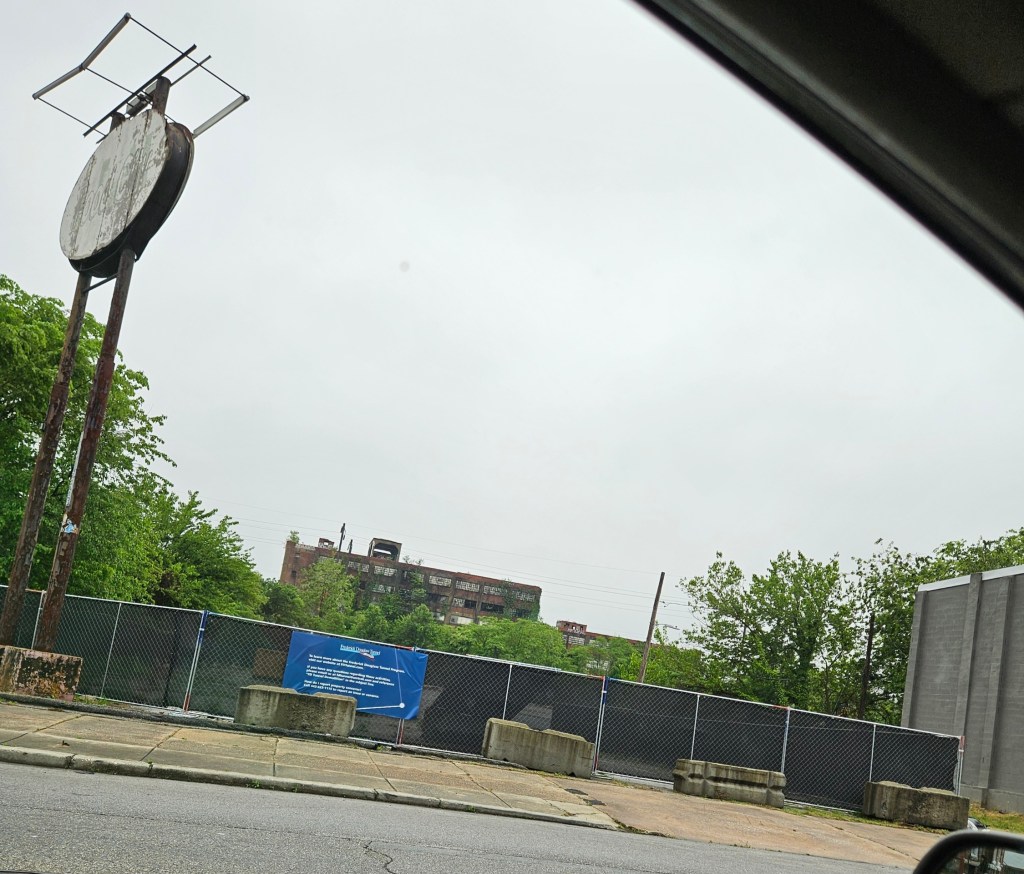
Ironically, at its groundbreaking in 1975, my grandmother, Lillian J. Barber, donned a hard hat to shovel out the first scoop of dirt, accompanied by prominent activist African-American pastors, Rev. Frank L. Williams and Rev. Marion Bascom, as well as the neighborhood’s then-City Councilman. [Unfortunately, the newspaper article about this event is not readily available.] For many years, she was able to walk to the store to do her grocery shopping. In later years, family members would drive her there and back, to load and unload her purchases more easily. In November 2000, Super Pride closed the last of its stores, including this one.
As if this weren’t troubling enough, in 2023, Amtrak acquired all of the mostly occupied properties on the even side of the 1000 block of Payson Street to create a critical part of the Tunnel [https://www.thebaltimorebanner.com/community/transportation/amtrak-demolition-ventilation-frederick-douglass-tunnel-PV6SI6JHY5BRVAYK2ZEWOW6NP4/]. This segment will require the ground to be lowered to 700 feet, so that trains can travel underground below the 900 block and emerge at ground level where the Super Pride used to be and continue aboveground below the Lafayette Avenue Bridge. Currently, the Amtrak trains run parallel to the dead-end 1000 block enroute to and from Penn Station-Baltimore (formerly B&O) in Midtown Baltimore.

The process of acquiring and scheduling the demolitions was long, beset by weather-related and other (systemic) delays. Initially, the demolitions were supposed to begin in November 2023, according to a postcard delivered to residents in the area , including my aunt, who has lived in the 900 block of Payson Street her entire life. To my knowledge, that postcard was the only direct written notice given.
The demolition of the first 6 houses, heralded only by the block being closed-off with orange cones (i.e., no written notification) did not occur until the last week of March 2024 [https://www.masstransitmag.com/rail/infrastructure/press-release/53097787/amtrak-crews-begin-demolition-work-for-amtrak-frederick-douglass-tunnel-program].


Between the end of March and early May 2024, the Reservoir Hill neighborhood and RATT garnered news stories about the impending threats to their homes and businesses [April 2024, https://www.cbsnews.com/amp/baltimore/news/baltimore-residents-worried-frederick-douglass-tunnel-construction-could-damage-historic-homes/; May 3, 2024, Reservoir Hill Civil files Rights Suit: https://www.cbsnews.com/amp/baltimore/news/baltimore-residents-file-civil-rights-complaint-against-amtraks-frederick-douglass-tunnel-program/; May 2024, https://youtu.be/g6xAAWRtR4Q?si=riCgq49jRy6pDuCg].
The next set of demolished homes was photographed on June 3 and 8, 2024, by Jackie Oldham. In addition to the crane (left photo), a large hose was sprayed on the bricks as they crumbled, mainly to curtail dust, but also serving to hasten the demolition (right photo).
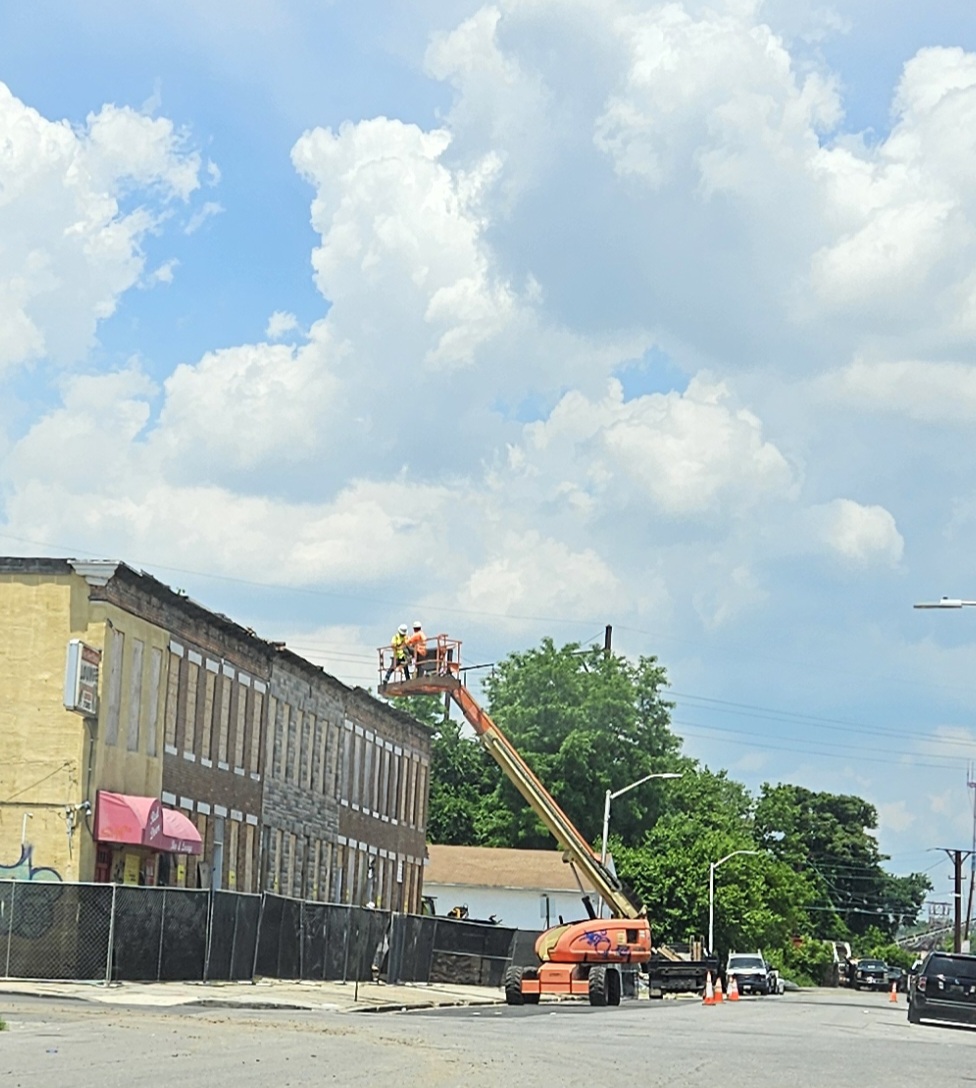

On June 14, 2024, the entire even-numbered side of the block was demolished. When I visited the site on Saturday June 15, former patrons of the Red Door Bar were setting up for a party under a tent in front of the fence at the corner of Payson and Mosher Street. Before long, cars filled the parking spaces in the 900 block, just as they had on many evenings. This time, however, there was no Bar, just an impromptu street party.
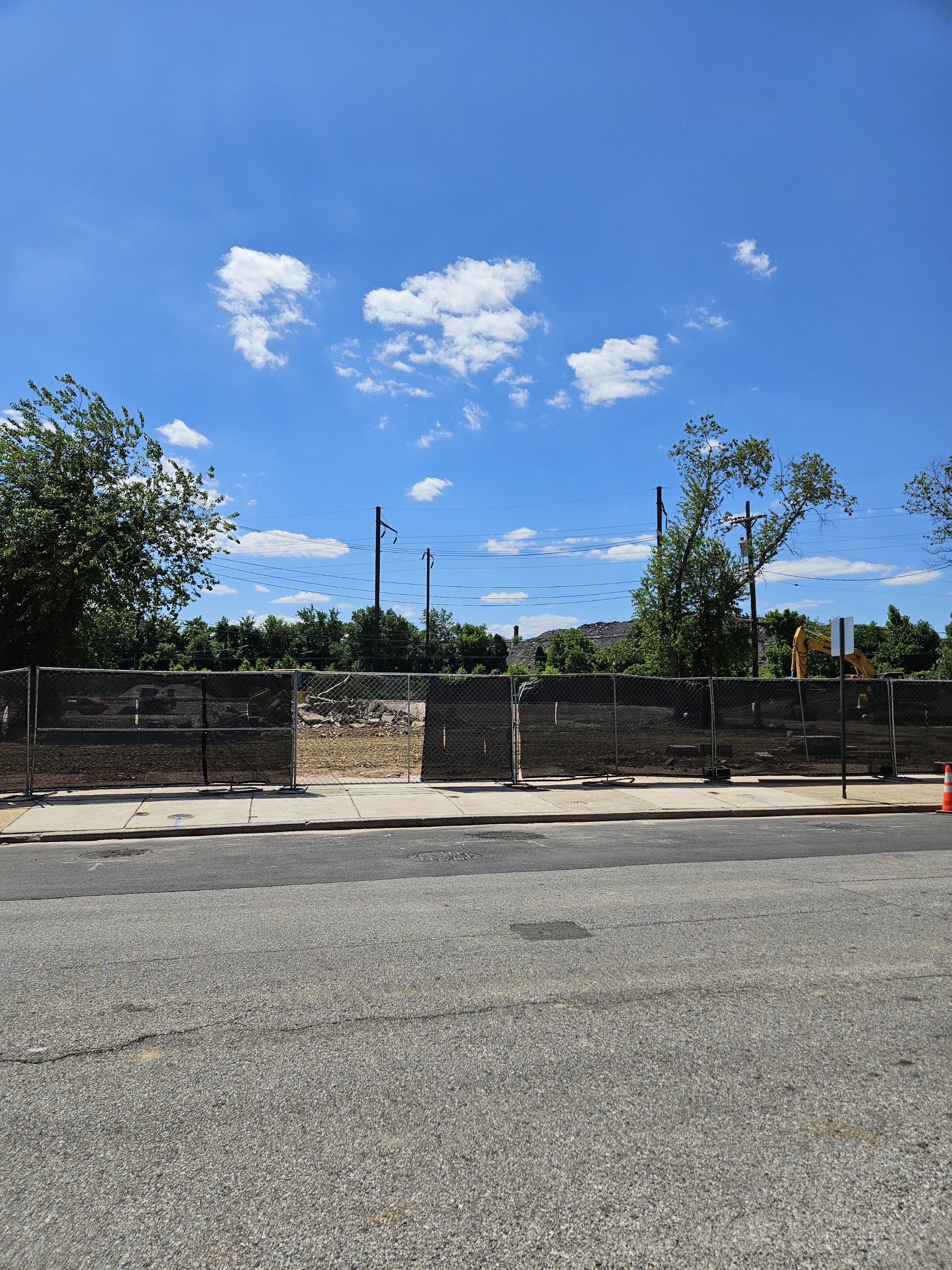

Over the last two weeks, some residents on the even side of the 900 block of Payson Street have been informed that their homes may be purchased by Amtrak and demolished, too. Never mind that a few of those houses were beautifully renovated over the last few years, or that new residents have only recently moved in. Amtrak, it seems, has spoken (eminent domain). Unlike historic Reservoir Hill, which has lost some stores but not many homes, the 104-year-old Sandtown neighborhood I once called home is on the fast track to oblivion.
 baltimoreblackwoman
l am also from the 1000 block of Payson and Am Trac are nogotiating 2 houses belonging to our family. Just think, When Super Pride closed this was already being considered.This is more than a 20 year plan. It’s impact is too devastating.
LikeLike
Thanks so much for your comment, Dexter!
LikeLike